

Pausing to mend is medicine, a small rebellion against the go-go-go. The calm, the focus, the spark, the head-to-toe magic. It’s real. Science has proven that acts of playful creativity improve overall wellbeing. (Besides, it's fun, and we could all use some fun.)
Mending is a joyful ritual of care for every part of you.
For Your Head
Play is a healthy act of defiance.In a world constantly vying for your attention, dare to slow down and incorporate mending as a mindfulness practice. Creative play has been scientifically proven to reduce cortisol levels (pesky stress hormones), while boosting dopamine and serotonin levels released in the brain.

For Your Eyes
Let mending tell the story.Every stain and rip contains a moment of life: How a late night karaoke with friends became a red wine stain on your favorite dress. Or when your skateboard shredding debut shredded your jeans instead. Repair gives you the joy of reliving these memories again and again.
For Your Hands
Reconnect to our humanity.The art of mending dates back thousands of years, when resourcefulness meant survival. While society shifts more towards the artificial, remaining tactile—in touch with the physical world, the people, elements and objects who inhabit it—has never been more pertinent.

For Your Home
Giving back is so en vogue.Going the extra mile to give your clothes a second life doesn’t just benefit you and your wellbeing, but it serves as an act of environmental kindness, too. And, hey, you didn’t hear it from us, but your one-of-a-kind closet is a pretty stellar perk.
The Science of Slowing Down
Curious what happens to your beautiful brain and body-ody when you mend and work with your hands? So were we. See what our research uncovered below.




You are getting very mendy ✨
You are getting very mendy ✨
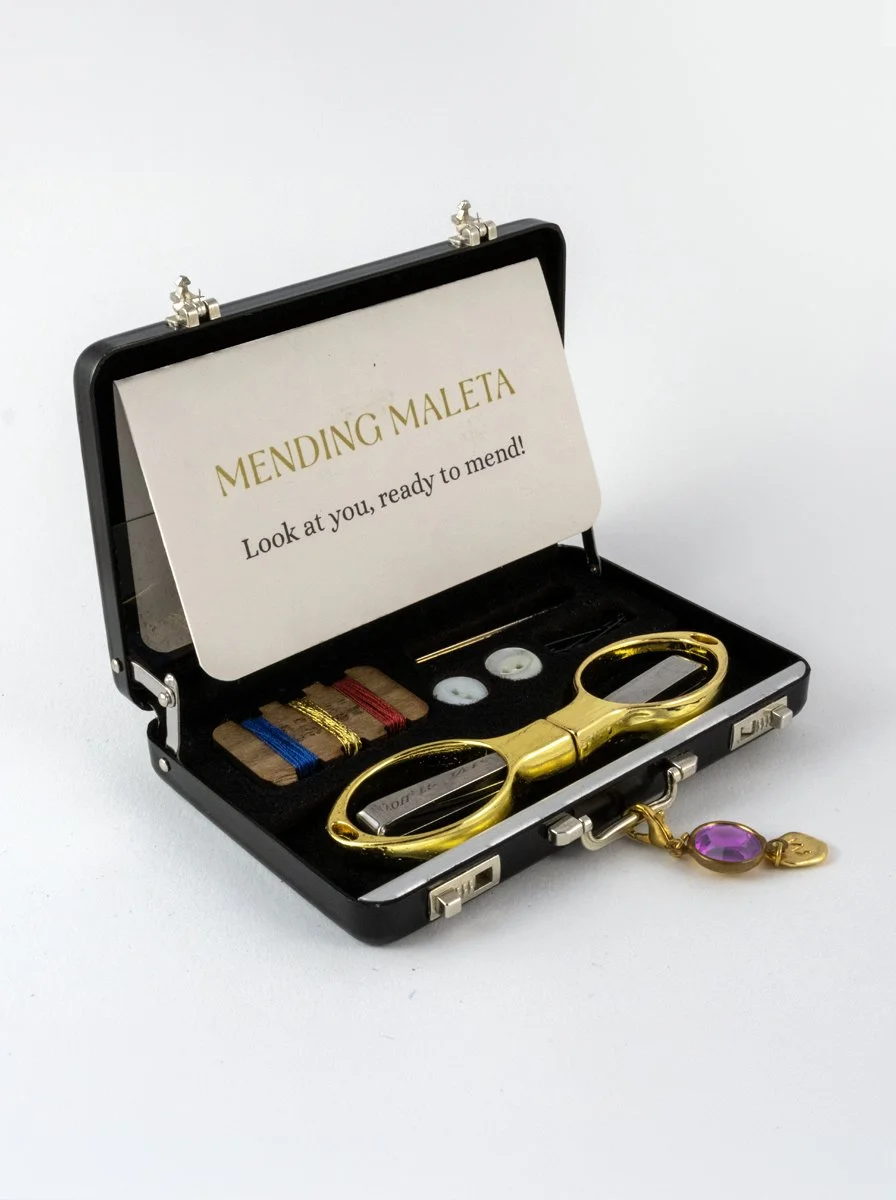
A miniature Travel Mode Suitcase Tin filled with mending essentials of the highest quality:
Gold needles for sewing and embroidery
Kintsugi-inspired metallic gold embroidery floss
Organic cotton sewing thread (Choose 2 colors. Note here that we’ll hand-wrap these on the walnut bobbin; you will not receive the entire spool.)
Thread bobbin (Made from walnut wood)
Oh-so-petite safety pins (Matte black)
1960s vintage mother of pearl fisheye buttons
Stainless steel foldable sewing scissors
Travel Mode Mini Wool Patches (You get 3 - score!)
14k gold alphabet charm and 1970s vintage Swarovski jewel (available while supplies last–let us know which initial & color you prefer)
Find your flow state with visible mending. In the spirit of kintsugi, we designed a petite Mending Maleta, including gold needles and gold embroidery floss.
Do you know about kintsugi? As ceramic aficionados and users of plates, we were inspired by the Japanese concept of kintsugi. Kintsugi is the art of repairing broken pottery with gold–which then highlights the cracks and celebrates its history. Instead of covering up the damage (or worse, trashing the whole thing), kintsugi asks us to accept change and imperfection. And maybe find more beauty in an object that's served you well.